


App Tracking Transparency on iOS 14.5: What are the impacts?

The App Tracking Transparency feature introduced by Apple with iOS 14 is disrupting the media and advertising industry. What are the consequences?
After blocking third-party cookies by default in March 2020, Apple is taking center stage regarding the collection of user data from App Store applications.
Since Monday, April 26, 2021, Apple has required app developers to obtain consent from each user to collect and process their personal data. This is done through what is known as App Tracking Transparency (ATT). We will explain what this is later in this article.
The app ecosystem is now being turned upside down.
The new measures taken by Apple have sparked significant debate on several levels:
A large portion of the Ad Tech and media sectors accuses Apple of opportunism, claiming it is using user data protection to serve its own interests.
Should Apple be the guarantor of personal data protection? By doing so, it is challenging the roles of regulatory bodies in each country (such as the CNIL in France).
Will Apple strictly enforce its commitments, even for Chinese apps like Tencent or WeChat?
Abuse of dominant position: Is Apple encouraging app developers to shift toward a subscription model, given that it takes a 30% commission on every transaction made within iOS apps?
Can we really blame Apple for prioritizing the consumer over the advertiser?
Each of these issues could be the subject of an entire article.
Here, we will focus on the impact of ATT on the media and advertising market.
🍪 The role of third-party cookies and Mobile IDs
Since the 2000s, the internet has been built around a free and open model. Most media outlets have shifted their business models toward advertising to support this.
User data remains the dominant currency today. It is stored in advertising IDs (cookies for the web, Mobile IDs for apps), which are used by advertisers to reach their audiences.
These IDs serve three main functions:
Retargeting app users or website visitors,
Managing ad frequency, particularly to respect the user experience,
Measuring conversions: page visits, add-to-cart actions, purchases... any relevant action on an app or website that you want to track.
🔐 ATT: what is it?
In its latest iOS 14 update, Apple introduced App Tracking Transparency (ATT). This feature requires app developers to be transparent with users regarding privacy and to obtain their consent before using their mobile ID.
Non-compliant apps risk being removed from the App Store until they are brought into compliance.
Apple device users will gradually start seeing a banner similar to the cookie banners we are already familiar with on websites.
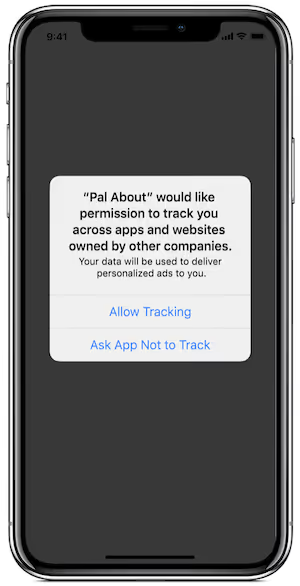
App Tracking Transparency on iOS 14
Customization is limited, but you can modify:
The timing. Developers can choose when to display this banner to minimize user frustration and increase consent rates.
The purpose. This explains why the publisher wants to collect the requested data. You can find this below the bold text.
💥 What are the impacts?
The winners
Apple
Apple comes out a triple winner.
The company is capitalizing on a topic that increasingly concerns users: personal data protection. While the company has been accused of pure hypocrisy, it must be admitted that the measures taken are objectively in favor of respecting personal data.
Hypocritical, because at the same time, Apple has opened up a second advertising space for advertisers on its App Store. A fine message of support for the many players who are losing out. This is expected to boost its advertising revenue.
If app publishers can no longer rely on advertising revenue, they will have to charge their users. It is worth noting that Apple takes a 30% commission on every transaction made within its ecosystem. Every iOS app, that is 👌.
E-commerce platforms & Web Analytics tools
The disappearance of cookies and a reduced volume of Mobile IDs will make analysis more complicated—though many projects to find alternatives are currently being developed and deployed.
However, on-site analytics are largely unaffected. Amazon, Walmart, FNAC, CDiscount, Carrefour... all these major marketplaces have enough volume to attract advertisers based on performance.
Web analytics tools like Contentsquare are also major winners in these market shifts.
While seemingly a loser (we will see why later in the article), Facebook could come out on top if it successfully develops its e-commerce and gaming segments. The idea is to grow its network and keep users within its ecosystem as much as possible to gradually break away from Apple.
As a reminder, Apple is making cross-site tracking and measurement (from Facebook to your site, for example) difficult.
Users who are staunch privacy advocates
Apple is indeed taking a major step toward an advertising world that is more transparent about how everyone's personal data is used. That is a fact.
Good news for user privacy advocates—based on what we know.
Branding vs. Performance channels
TV, audio, video, YouTube, DOOH (digital out-of-home), in-game advertising, Twitch, game consoles... these are all channels that do not rely on tracking, as they are primarily used for branding and audience engagement.
Please feel free to contact us to learn more about the branding channels we can help you with.
The losers
Users and ad-blockers
It is becoming much more difficult to serve relevant ads to users, as mobile IDs cannot be leveraged in the event of an opt-out.
This means the user experience will be impacted once again, as users risk being exposed to ads that have nothing to do with their interests.
I should qualify this, as it is already the case on Safari and Firefox. So far, I have never heard a user complain.
Content publishers
There are two points on which publishers are penalized.
The reduction in available mobile IDs has a direct consequence: a drop in advertising revenue.
Shifting from an ad-based model to a subscription model would require publishers to pay 30% of their revenue to Apple. It is not certain that everyone can afford that.
Facebook again
Facebook, of course. Since measurement is more complicated to manage, Facebook will have a harder time demonstrating the effectiveness of campaigns run on its platform to advertisers.
The company had to take steps to adapt its entire attribution and measurement model for advertisers and agencies. These include:
The 7-day post-view and 28-day post-click attribution window is no longer possible.
We are now moving to a 1-day post-view and 7-day post-click model.
1-day post-click attribution for users who have opted out.
For iOS 14.5 and later, it will no longer be possible to obtain demographic or geographic information for conversions (age, gender, region, and placement). You will still be able to analyze your figures on Google Analytics.
Advertisers will need to verify their domain name to allow conversion data from their site to be reported.
📊 Initial stats for the opt-in rate
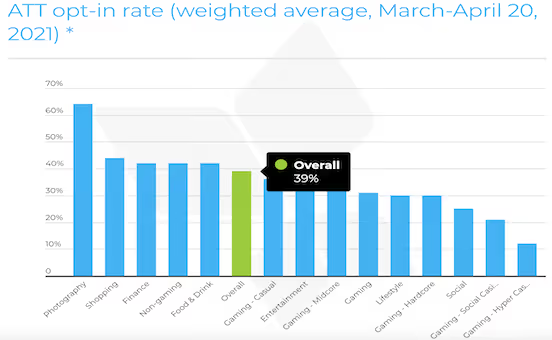
Despite this news, AppsFlyer has released initial stats on consent rates. These figures are higher than expected. This is good news.
39% vs. an imprecise range previously announced between 2% and 20%.
The study was conducted on 550 apps and should be updated as everyone becomes compliant with App Tracking Transparency.
Stay tuned!
💡 What is the impact on your campaigns and your clients?
For your Branding & Engagement campaigns
> No impact on measurement: impressions, clicks, video views, YouTube views, audio listens, and interactions are not affected.
> Channels more focused on branding (DOOH, TV, Audio, Video, In-Game Advertising, Console, YouTube, Twitch, etc.) remain just as valuable with programmatic.
Contextual and semantic targeting remain unaffected.
For your in-app conversion campaigns
In-app conversion performance may see a slight decline on iOS 14.5+ versions. This does not mean that campaigns are less effective.
The retargeting audience for iPhone users may shrink.
Changes at Facebook
Facebook is moving to a 1-day post-view and 7-day post-click model. Klox has always used this model, so there is no impact here.
1-day post-click attribution for users who have opted out.
You will need to verify your domain name with Facebook.
This article will likely need to be updated in the coming days, weeks, and months. This is an exciting market that requires us to constantly adapt.
I would be happy to discuss this with you via email or on my LinkedIn if you have any comments or questions.
Klox is also available to support you with your branding and customer acquisition challenges.
See you soon 🔅

Stay up to date and subscribe to our newsletter