


AI & Marketing: balancing performance with AI Act compliance
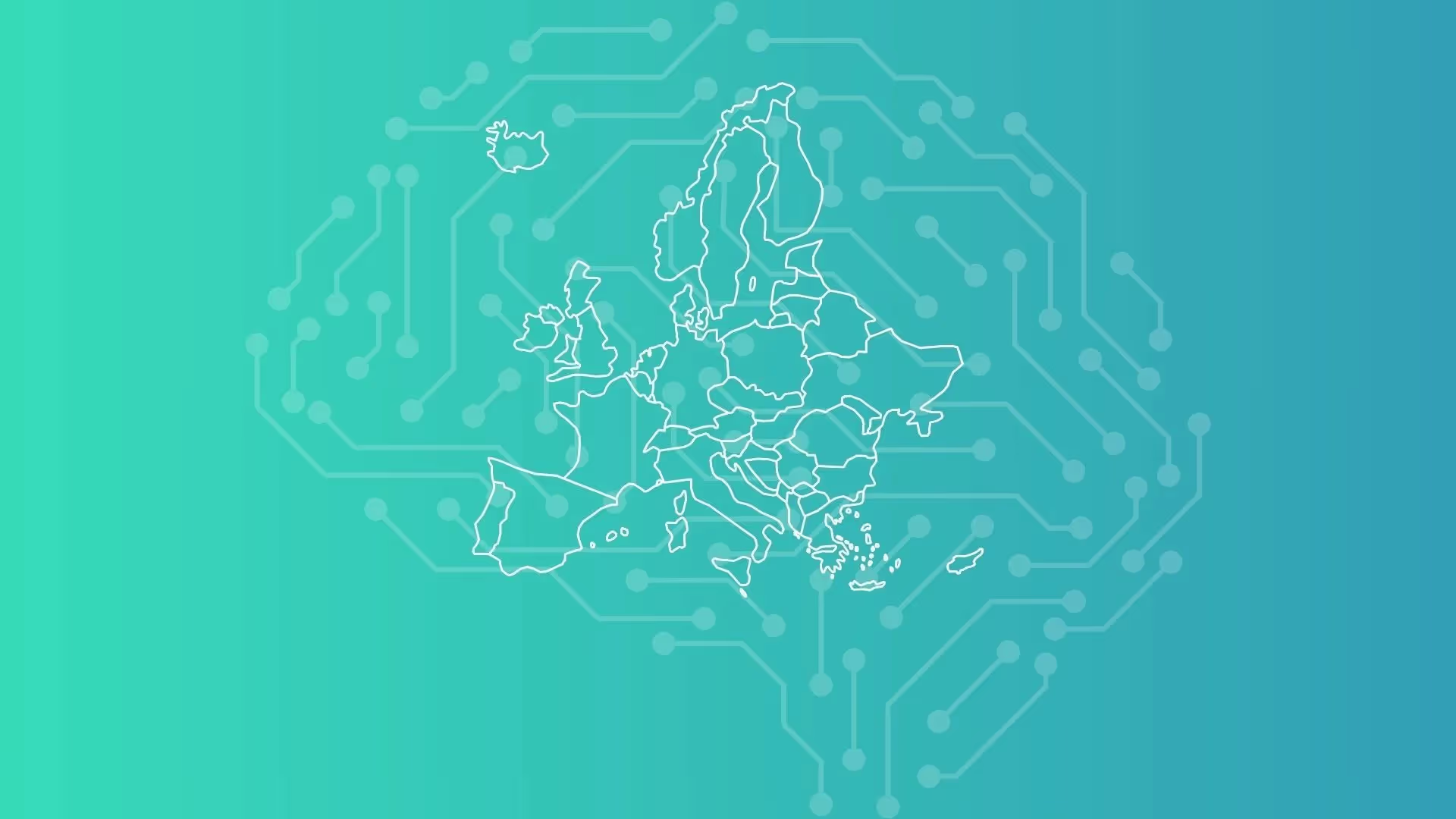
Artificial intelligence is already becoming an essential tool in marketing. However, its rise raises new ethical and regulatory questions, which Europe has decided to address through the AI Act, the world's first legal framework dedicated to AI.
For marketers, this is both a challenge and an opportunity: how can you leverage AI to boost performance while remaining compliant with European standards? A complete breakdown.
The AI Act: A major turning point for AI in Europe
Even before the massive arrival of ChatGPT and generative AI, the European Union anticipated the need to regulate this technology. In 2021, the European Commission presented the draft AI Act (or European AI Regulation), which entered into force on August 1, 2024 and will be implemented gradually until 2027.
🔎 According to the CNIL, this unprecedented text aims to:
- Regulate the development, market launch, and use of artificial intelligence systems.
- Limit risks to health, safety, and fundamental rights.
- Strengthen transparency and personal data protection.
In short, Europe intends to position itself as a pioneer of responsible, ethical, and secure AI, unlike other regions of the world (the United States, China) that are more focused on innovation at any cost.
---
In more practical terms, the AI Act is…
The AI Act clearly defines what you are allowed or not allowed to do with AI based on 5 risk levels :
- 🚫 Unacceptable : manipulation, exploitation of vulnerabilities, social scoring, biometric categorization.
- ⚠️ High-risk : health, justice, education, essential services → human oversight, documentation, bias mitigation.
- ℹ️ Specific : AI that interacts with people or generates content → obligation to inform the user.
- 💡 General-purpose AI : transparency regarding training data and technical documentation.
- 🌐 Systemic risk : highly powerful AI → adversarial testing, cybersecurity, incident reporting, energy monitoring.
Control & sanctions : audits, certifications, internal governance. Non-compliance can cost up to 7% of global annual turnover.
---
A lively debate between innovation and regulation
On July 3, 2025, 45 major European tech groups requested a two-year "pause" in the implementation of the AI Act, arguing that this regulation risked stifling innovation and widening the gap with American and Chinese competitors.
🇪🇺 The European Union rejected this request, arguing that, on the contrary, good regulation fosters innovation by creating a framework of trust (government source).
👉 Result: as of August 2, 2026, all provisions of the regulation will be applicable. For marketers, this means learning to integrate AI within a clear and standardized framework, without delay.
---
AI adoption in Europe: caution and potential
AI is already widely used by marketing professionals:
- 92% of marketers believe it has a significant impact on their profession (Hubspot).
- 96% of social media managers report using it daily (Metricool).
However, among the general public and businesses, adoption remains more measured:
- In 2024, only 10% of French companies reported using AI, compared to an average of 13% in Europe, and up to 28% in countries like Denmark or Finland (La Tribune).
- 39% of French people actively use generative AI, especially those aged 18-24 (nearly 75%) (IPSOS).
➡️ In short: France is starting from further behind than its neighbors, but the growth potential is immense. For marketers, now is the right time to get ahead and experiment.
---
Transparency: an imperative for reassuring consumers
Distrust remains high in Europe. For an AI-driven campaign to be well-received, it is crucial to play the transparency card.
Examples:
- During the Super Bowl, OpenAI intentionally aired a commercial created entirely by humans : a strong signal to remind everyone that AI is not here to replace human creativity.
- Conversely, the Coca-Cola Christmas ad, created solely using AI, was criticized for its lack of authenticity.
- But, Carrefour launched a 100% AI-generated back-to-school campaign that was very well received (case study here), while Sephora used AI for an Italian campaign raising awareness about domestic violence (video).
➡️ The takeaway for marketers: AI should be used with relevance and restraint, as a tool to support a human message.
---
Best practices for integrating AI into marketing while complying with the AI Act
To stay competitive and compliant, here are a few key principles:
- ✅ Transparency : clearly indicate when and how AI is used in your campaigns.
- ✅ Data compliance when using AI to process customer data: ensure collection is minimal, anonymous, and secure.
- ✅ Human oversight : always maintain editorial control over generated content.
- ✅ Combating bias : check your prompts and results to avoid discrimination or stereotypes.
---
AI Search: Integrating GEO
Despite cautious adoption in Europe, AI is becoming part of everyday life. Consumers are using it, companies are experimenting with it, generative AI tools like ChatGPT are becoming our search engines.
👉 For marketers, this means it is already time to think about GEO (Generative Engine Optimization), an extension of SEO adapted for new conversational engines like ChatGPT, Copilot, or Gemini.
GEO involves optimize your content so it is understood, selected, and cited by AI.
---
AI search optimization: integrating GEO now
Even though adoption remains cautious in Europe, AI is already part of everyday life. Consumers are using it, companies are experimenting with it, and most importantly: generative AI tools like ChatGPT are gradually becoming our search engines.
👉 For marketers, this is a clear signal: working on traditional SEO is no longer enough. You need to integrate GEO (Generative Engine Optimization), a new approach designed for conversational engines like ChatGPT, Copilot, or Gemini.
GEO aims to make your content readable, understandable, and recommended by AI.
➡️ Not preparing for GEO today means letting your competitors get ahead and risking invisibility in AI-generated responses.
To learn more about this topic, check out our full article right here.
---
Conclusion
Artificial intelligence opens up an immense field of marketing opportunities, provided it is used in a reasoned and ethical manner. The European AI Act now sets the framework, and consumers expect transparency and accountability.
But AI is not just a tool to be handled with caution: it is also a new landscape for visibility. To ensure your competitors don't get a head start, integrate Generative Engine Optimization (GEO) into your marketing strategy today.
👉 Check out our article dedicated to GEO and subscribe to our newsletter 💌 to stay up to date with the latest marketing and AI trends.
.avif)
Stay up to date and subscribe to our newsletter