

#food: what strategy to optimize drive-to-store?
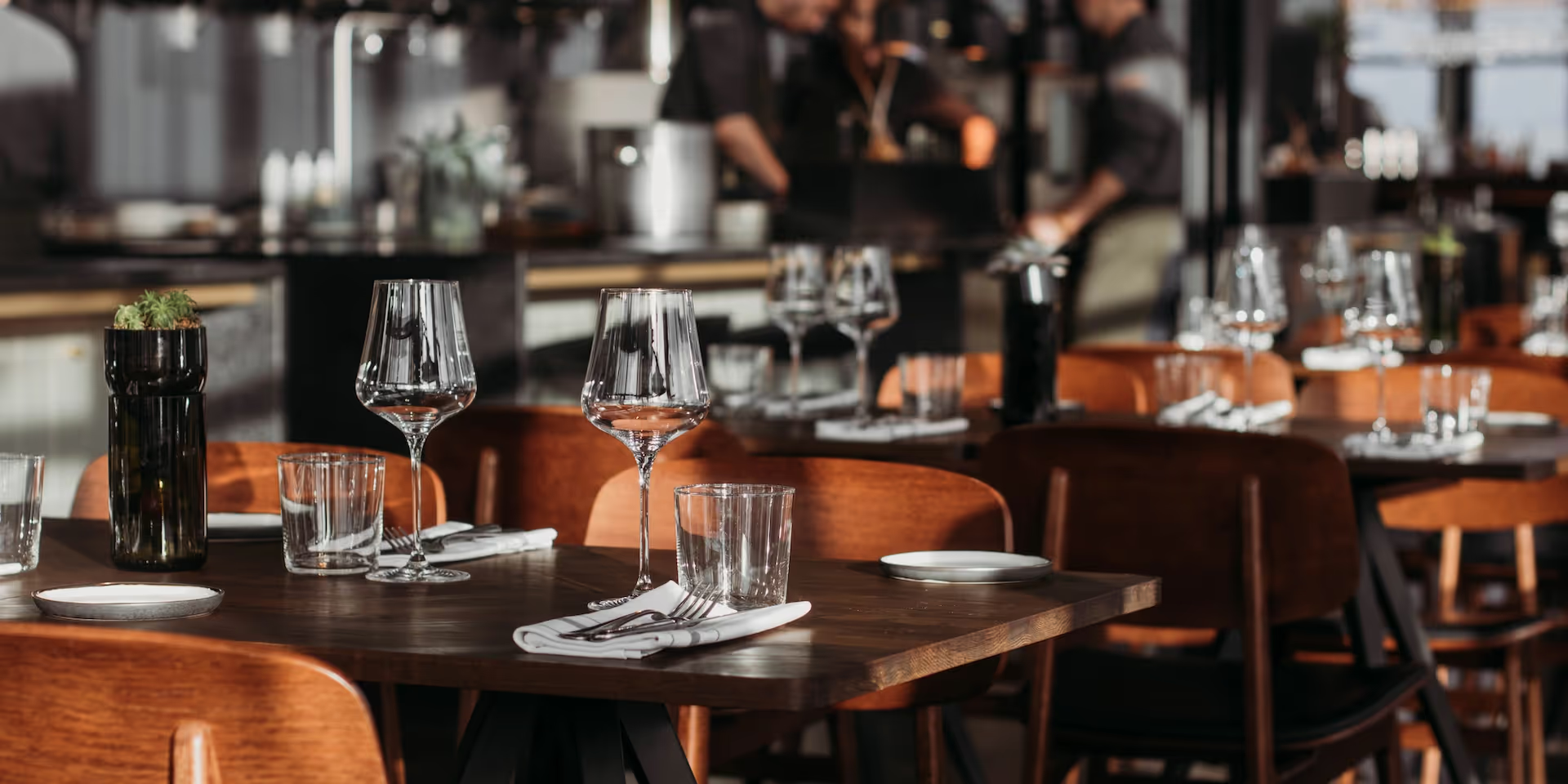
🚀 The food market is growing exponentially, the restaurant industry is going digital, and home delivery has exploded since the lockdowns. It is a hyper-competitive sector with over 175,000 establishments in France, emerging trends, and new consumer expectations. In short, the food industry is a gold mine—you just need to know where to dig.
We’ll tell you more about how to convert this target audience, for whom food is becoming increasingly important. 🍔
📱 Digital habits and hyper-competition
The digitalization of society has brought about many changes in the habits of the French. And significant ones at that, given the explosion of takeout, click-and-collect, and home delivery.
The internet has become the primary driver for choosing a restaurant (80% of French people make decisions based on information found online) and for booking a table (50% book their restaurant online). 📈
This evolution is certainly linked to the massive rise of digital, but it also stems from the fact that consumers no longer have time to spare. The new motto: eat fast but eat well! Indeed, while time is of the essence, the concern for healthy and responsible eating is a top priority for consumers. Organic, local, vegetarian, and vegan options are all criteria that are surfacing in consumer demands. The awakening of an ecological conscience and a generation concerned about the world they live in creates challenges that restaurateurs must take into account. 🌱
📍 Restaurant communication
If consumer habits are going digital, the same is true for the restaurant industry. When it comes to communication, the assessment is quickly made. The food sector is driven by channels that generate numerous interactions and dominate mass culture. 👑 Instagram, Twitter, and Facebook are the kings of #food. While the popularity of these networks can certainly help restaurant communication, the saturation they experience drowns users in a vast flow of information. Advertising gets lost, and advertisers struggle to find their way. 😕
Food industry players communicate via social media, search, and display. Tens of thousands of them are doing the same. Today more than ever, advertisers must adopt a cross-channel strategy to surface, stand out, and convert consumers.
🔥 Innovative levers that adapt to your targets
A hyper-competitive market that never stops growing, with new trends emerging. In short, a whirlwind in which restaurant players must fight to establish their reputation and stand out. While search, display, and social media have proven their worth, other, more disruptive and innovative levers are emerging. 😍
So, what are the levers for a drive-to-store strategy? The goal is to convert your targets by encouraging them to visit your establishment. So why you instead of someone else?
💥 Conversion Goal
▶▶ DOOH: Digital Out Of Home
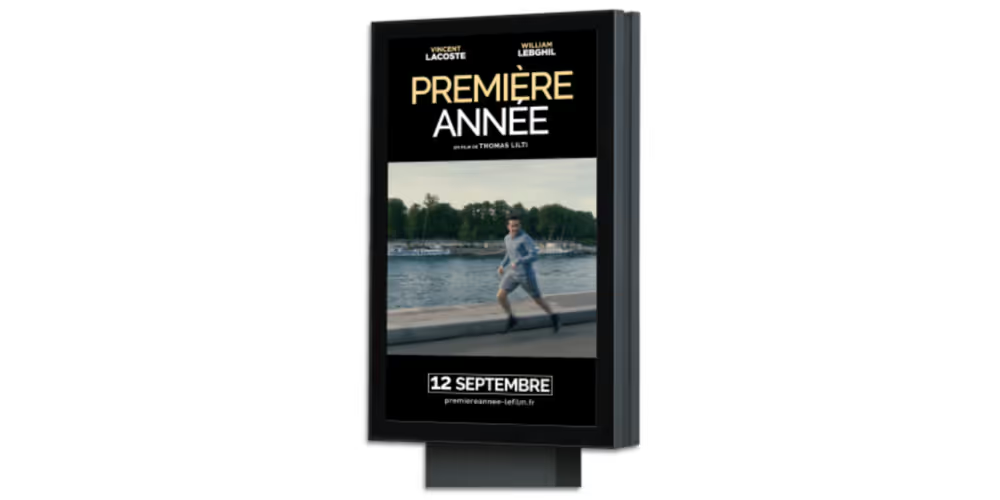
DOOH is an advertising delivery lever that allows you to target the catchment area of your points of sale. It stands out as a powerful way to reach an audience in the vicinity of your restaurants. Using animated banners or video formats, it is possible to broadcast an ad at specific times while choosing strategic locations for delivery. 🙌 Every location has its target. With Klox, you can target all gas stations in France, thanks to our access to the ad network, and reach motorists. This example illustrates a national strategy that can serve a restaurant chain. Conversely, you can target only the stations that are relevant to your brand, in the case of an independent restaurant, or in a local conversion context.
As just one example among many, DOOH applies just as well to the surroundings of cultural venues (concert halls, bookstores, cinemas) as it does to places conducive to shopping 🛒 (boutiques, shopping centers, hypermarkets...) or even in train stations, subway stations, and airports... In short, whatever your target, we have the means to reach them based on the places they frequent. The advantage lies in broadcasting an advertising message in the immediate environment of a point of sale for a direct impact on your targets.
📌 Geolocation-based programmatic
Deploying a geolocation-based programmatic marketing strategy means reaching the right person, at the right time, in the right place. In other words, programmatic advertising allows for audience refinement based on geographic location, resulting in effective engagement and conversion rates. The benefit? Building a closer relationship between a brand and its customers. 💥
Two types of geolocation-based programmatic:
The first targets a geographic area, where the campaign deployment focuses on a defined space: a city, region, or department. The second targets a specific location with precision: a restaurant, a bakery, etc. In this strategy, the advertisement is directed at people who are in the immediate vicinity of that location.
👉 This lever offers a range of possibilities for tailoring your message to your target audience, thereby maximizing conversions while keeping costs down.
Want to know more? Click here!👇
📻 Radio
Every radio station has its own unique world and audience. Broadcasting an audio spot can be done locally, helping you reach your target audience effectively. These campaigns maximize the number of people reached within your catchment area in a short amount of time. 🎯 Radio builds brand awareness, as message repetition keeps the brand top-of-mind for listeners. This lever is particularly strategic for the food sector, given that peak traffic hours closely align with meal times. Indeed, there is a high density of drivers between noon and 2:00 PM and again in the late afternoon—the perfect opportunity to deliver a message. Radio is a goldmine for local drive-to-store strategies.
🎧 In the collective consciousness, radio is something you listen to in the car, and while statistics support this, listener habits are evolving due to the rise of podcasts. Whether native or on-demand, this format is gaining momentum, and it is modernizing radio. As a result, radio shows can now be consumed anywhere at any time. Every month, 21% of internet users listen to them, a 9% increase in one year (2020 figures). By using podcasts as a communication channel, brands foster a positive reception of their message. Plus, the advantage is that you can still apply geographic targeting.
🚗 Waze
Speaking of drivers, it’s impossible to overlook Waze. Google’s app has nothing left to prove: it now has 16 million monthly users in France. Through Pins, Search, Takeovers, or Arrows formats, target drivers where it makes sense for your business. Because geolocation is intrinsically linked to the app, a strategy based on a drive-to-store objective makes perfect sense. You can actually guide drivers directly to your establishment. 💥
🌍 Le Routard
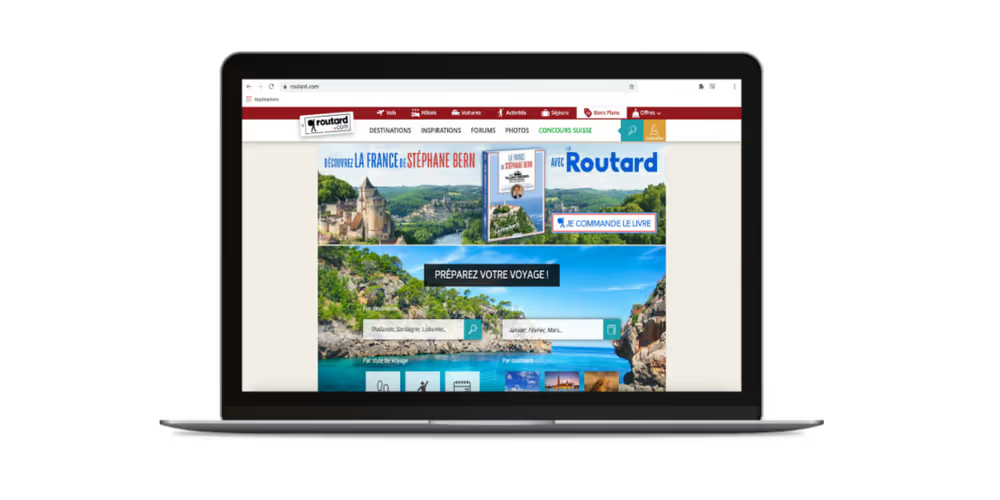
Dedicated to a target audience of travelers, Le Routard has 3 million monthly users. It is the essential, go-to tool for adventurers, whether they are novices or experts. As proof, it ranks as the number one editorial site for travel guides and boasts an active, engaged forum community with over 400 posts every day. Managing catchment areas, whether at a local or regional level, positions Klox as a key player in your strategies. Through our various partnerships and expertise, we have the ability to implement multi-regional campaigns, ensuring that our advertisers' ads reach their audience and maximize store visits.💣
💥 Branding Objective
Vinted
With the rise of e-commerce and the surge in second-hand goods, this clothing buying and selling app has been all the rage in recent years. Vinted is a massive success, bringing together 10 million members in France and ranking as the tenth most-visited e-commerce site according to Médiamétrie.
🔎 Vinted is popular with 18-29 year olds, who make up 60% of its user base. It’s an interesting channel for a branding strategy, as repetition will anchor your brand in the minds of consumers. Building brand awareness complements conversion goals.
▶▶ DCO: Dynamic Creative Optimization
Restaurant operators face the challenge of managing local communication on a large scale. It is impossible to create as many advertising campaigns and visuals as there are individual locations. DCO allows you to automate the creation of ad formats by displaying, for example, the name of the nearest store and a photo of its storefront. When served on publisher websites that align with your target audience's interests, display ads simply hit the mark. DCO cross-references your target audience's data with their environment and external context. In short, the recipient sees an ad that takes into account their consumption habits, browsing history, interests, and intent.
👨👩👦👦 Focus on the family target
Why focus on families? With an average basket of 30 euros per meal, families visiting restaurants to enjoy quality time (67% of families), and a majority of them letting the children choose the establishment, family outings are prime opportunities to reach this target and encourage them to visit your restaurant.
Family activities include cinema trips, sports complexes, swimming pools, and ice rinks—all dream opportunities when you consider that DOOH allows for geographic and real-time targeting. It’s a great way to strategically highlight your establishment.
Watching TV as a family is also a common household activity, which is increasingly shifting toward streaming movies. It is therefore possible to run your ads before audiovisual content to engage families. Since children are the little decision-makers when it comes to choosing restaurants, it is even more relevant to target them while they are with their parents. Whether it's linear TV or replay, movies offer great potential if you focus on cartoons, comedies, or simply family-oriented films.
👍 Traditional levers that are still essential
As we have said time and again, social media, as well as SEA and Display, are used by a large number of advertisers. The power of an advertising message can get lost in a dense stream of information. However, the importance of being present and active as a restaurant operator remains undeniable. When integrated into a cross-channel strategy, this approach becomes even more relevant and effective. 💡
✅ Social media
Food is a passion that is exploding and shining bright ⭐
The holy grail of visual communication is Instagram. A network favored by both amateur and professional photographers, it has established itself as the most popular channel for food content. With hashtags galore and stories for every occasion, it is clearly the lever to get people talking about your brand! 89% of 12-25 year olds are on the platform, and it goes without saying that influencers play a full role in users' culinary destinations.
In a similar vein, the number of tweets referring to food is spectacular, with 22 million posts per year on the subject, 62% of which are posted by 18-34 year olds.
As for Facebook, 40% of users view content related to gastronomy, and 28% share it. It is a network that brings together several generations; while it is customary to think that Facebook targets young people, the trend is shifting toward an older audience.
To wrap up the classics, YouTube also positions itself as a temple for food, as the subject is among the top 5 most-watched themes on the platform.
From a branding perspective, social media allows for message repetition and works to build both brand awareness and brand image. It is through this repetition that the strategy pays off for click-and-collect services.
👋 Despite the multitude of advertisements, you can stand out by using formats that break the mold. At Klox, we offer formats and ways to showcase them that increase your visibility!
✅ Search: SEA
🤯 Food consumers spend time researching information about brands and products. While their time spent on social media is considerable, Google remains unbeatable for answering all types of queries. This naturally leads us to SEA, or paid search. The idea, or rather the goal? To make your brand appear in the top Google search results to maximize visibility and convert your target audience.
By leveraging programmatic advertising, Klox utilizes highly precise targeting and ad optimization methods, allowing us to reach food enthusiasts based on both socio-demographic and psycho-sociological criteria.
✅ Display
You know the drill: static or animated banner ads, refined targeting based on user interests, and a multitude of placements. But display also offers original formats: 360° view banners, augmented or virtual reality, stories, and much more. Speaking of innovation, we should also mention cause-based advertising formats, which allow advertisers to engage with the causes that matter to them. It’s an effective call-to-action that can be further personalized through DCO. 🧐
👉 In short.
📢 In short, boosting drive-to-store conversion strategies for restaurant businesses to disrupt industry norms is essential today. You can now move beyond standardized communication and adopt a cross-channel strategy. As an Agency As A Service, our programmatic expertise provides access to a range of innovative products, exclusive partners, and optimal targeting. Klox also delivers high-performance management of catchment areas, whether at a local, national, or international level.
Stay up to date and subscribe to our newsletter