


Connected TV Advertising: Why you should be interested in 2022
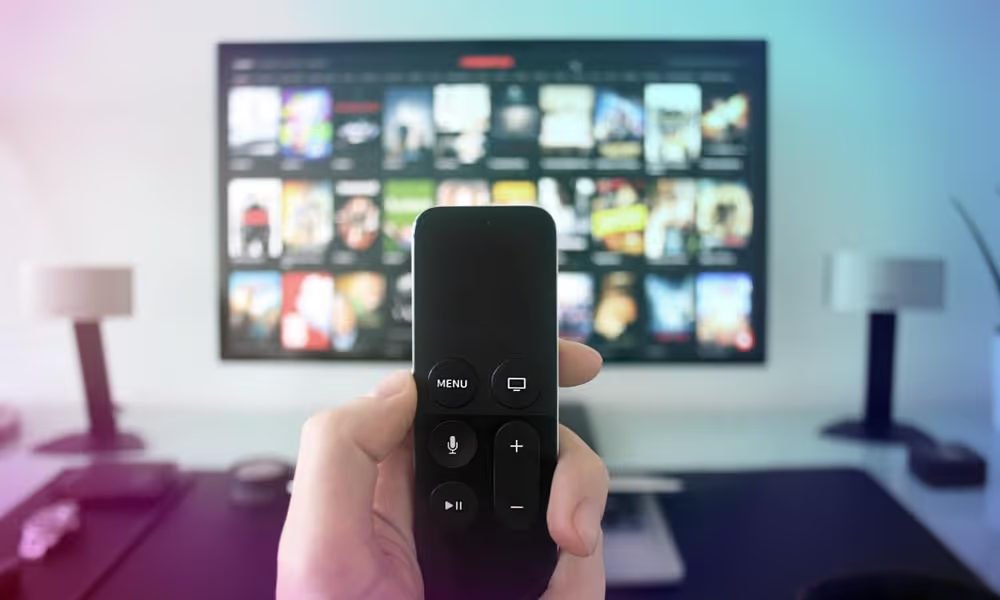
Connected TV is revolutionizing television advertising. It offers numerous benefits to advertisers compared to linear TV buying.
The freedom to watch programs, series, or movies whenever you want and on any screen has become the standard for consumers.
This advancement in user experience has clearly accelerated the shift of audiences from linear television (traditional broadcast TV) to Connected TV (CTV in advertising jargon).
The 2021 Super Bowl audience is the perfect example: the event recorded its lowest linear viewership and its highest streaming numbers in the last 10 years.
What is Connected TV? 📺
In the advertising industry, the term Connected TV refers to televisions and devices that stream video content via the internet to a TV screen. Video content viewed on a smartphone, computer, or tablet does not fall into this category.
There are currently three types of CTV products on the market:
Smart TVs which have a built-in internet connection,
Streaming devices such as Roku, Apple TV, Chromecast, or Amazon Fire Stick.
Video game consoles such as Xbox or PlayStation.
Connected TV has gained popularity with the rise of streaming services like Netflix, HBO, Disney+, Amazon Prime Video, OCS, Canal+, and others. However, this subscription-based streaming market is becoming saturated: few consumers can afford to pay for every service.
This is why new platforms are offering video-on-demand services based on an advertising model. These include, in particular, Pluto TV which is owned by ViacomCBS, Tubi (Fox), Xumo (Comcast), and Sony Crackle (Sony Pictures Entertainment Company).
You are probably not familiar with them yet because this model is not yet widespread in France. That said, Pluto TV launched in France last February and already lists a total of 50 available channels. The platform has also signed a deal with the audiovisual group Mediawan—founded by Xavier Niel and Mathieu Pigasse, among others.
This new market obviously offers enormous opportunities for advertisers looking to reach their audiences through an impactful channel. The catalog of TV programs is expanding, and we will also see later in this article that CTV provides clear advantages over linear TV.
Connected TV vs. Over-the-Top (OTT): What’s the difference? 👀
As explained in the previous section, Connected TV encompasses all devices that allow video content to be streamed on a TV, as well as the television sets themselves—via the internet.
Over-the-Top (OTT) refers to video streaming content delivered via the internet, as opposed to traditional cable television services. It does not specifically include the notion of the playback device, as is the case with CTV.
CTV by the numbers 🔢
According to a study conducted by eMarketer at the end of 2020, revenue generated by CTV advertising was expected to reach $8.11 billion in 2020 and is projected to reach approximately $11.36 billion in 2021, representing a 40% growth.
It is always interesting to look at trends in the United States, as they seem to be replicated in France, the UK, and Germany one to two years later.
According to the Conseil Supérieur de l'Audiovisuel (CSA), 81% of households in France are equipped with systems for streaming video via the internet. The majority use internet boxes (Free, SFR, Orange, Bouygues, etc.), but there is strong growth in the adoption of Smart TVs and streaming devices.
Benefits compared to linear television 🚀
Measurement capabilities. Unlike advertising campaigns on linear TV, CTV advertising allows advertisers to have a real-time view of their campaign performance, thereby providing greater transparency.
Flexibility & Optimization. The ability to test multiple videos in parallel and replace them at any time is a significant advantage. This flexibility proves essential for advertisers when they need to pivot in response to certain events or announcements. The health crisis is a good example, as it required regular and rapid adaptation to government announcements. It is also possible to reallocate your budget during a campaign based on the performance of each targeting segment, for example.
Time savings. From planning to activation and negotiation, scheduling a linear TV advertising campaign could take several weeks. Everything was managed through meetings, emails, and calls. CTV advertising, on the other hand, is managed using programmatic tools that allow us to automate a large part of the process. It is possible to launch your campaign in just a few days—subject to availability.
More accessible. No more advertising reserved exclusively for the market's biggest players. The ability to purchase TV inventory programmatically helps significantly reduce minimum investment budgets, thus welcoming new types of advertisers to the screen.
Targeting. While only contextual targeting is applicable in linear TV—meaning by program or category of programs—CTV offers advertisers a much wider range of targeting options. Today, it is possible to target based on user interests, geography (notably using IP addresses), or sociodemographic information such as age and gender.
Cost-effective. It is economical because audience segmentation allows you to invest your budget only on the target audience segment or a specific region, rather than the entire country.
Furthermore, the automation of processes (buying, selling, planning) via programmatic technologies has led to more attractive CPM costs than those of traditional television.
The challenges of tomorrow? 🔈
The online television advertising industry is expanding rapidly, and major media players are in a race to capture the largest market share and potentially impose their own models.
The market is currently very fragmented, and collaboration/cooperation between these players is very low. The lack of a standard makes identification impossible across different platforms or channels. Some players, like Liveramp, are attempting to deploy a universal advertising ID that could be used by all providers.
Yet, it remains a cornerstone of modern advertising, as it notably allows you to:
Precisely measure advertising campaigns (Attribution, Reach). It is currently difficult for advertisers to know if there is audience overlap between different platforms. How can you analyze "incremental reach"?
Analyze and manage exposure frequency—which is very important for TV media, as viewers are more easily annoyed.
How do you launch a TV campaign? ☀️
What is the budget? 👇
The myth that you need a minimum of €20,000 to launch a television advertising campaign is over. Programmatic advertising allows all ad networks (and therefore agencies) to remove these barriers to entry.
These technologies make advertising much more accessible for advertisers. This is great news.
You can start running your own campaign with €2,000. That said, this budget may not allow you to choose multiple programs managed by different partners.
Please feel free to contact us if you would like to learn more about this.
What about targeting? 🎯
Four types of targeting are available for this channel.
Geography. 📍
It is now possible to target specific regions or departments. This is a major breakthrough for local businesses, which can now include this channel in their marketing mix.
Interests. With your consent, it is possible to define a typical profile based on the most-watched programs. For example, we could identify sports enthusiasts or cooking fans (we know you Top Chef fans on Wednesday nights... we see you 👀).
Demographics. 🚶🏻
Some platforms may require you to register to enjoy their catalog of movies, documentaries, or series for free. Age and gender are generally requested, and this data can be used for marketing purposes.
Contextual. Sports, Business, News, Kids, Music, Culture... we have put together numerous "contextual packs" for you, giving you the choice based on your target audiences.
Which KPIs should you track? 🤪
Television has historically been a branding tool, both because of the screen size and the context in which it is used (with family, friends, etc.).
On the night of a World Cup football match, it is likely that more than one person is in front of the screen 😉.
We will focus more on CPM (Cost Per Mille impressions) as well as CPV (Cost Per View).
How long does activation take? 🕘
Activation time can vary depending on the partner. On average, it takes just two days to activate your advertising campaign once we have received all the necessary assets for launch.
However, it can take up to five days for others.
2021 was still a year of negotiation between telecom operators and television channels in France to reach agreements on value distribution regarding addressable TV.
2022 marks a fresh start. Available inventory continues to grow, which is excellent news for advertisers. So, please don't hesitate to contact us if you would like information on availability and pricing.

Stay up to date and subscribe to our newsletter